
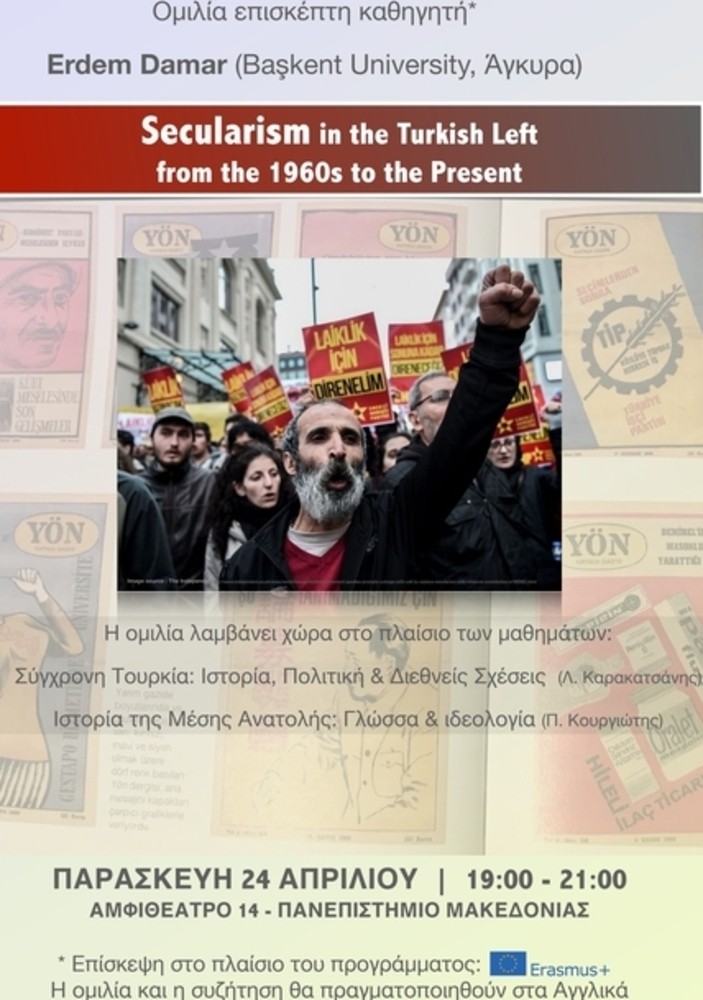
Στο πλαίσιο της συμφωνίας Erasmus+ μεταξύ του Τμήματός μας και του Τμήματος Πολιτικών Επιστημών του Πανεπιστημίου Başkent (Άγκυρα), θα επισκεφθεί το Τμήμα μας ο συνάδελφος Δρ. Erdem Damar, Επίκουρος Καθηγητής Πολιτικής Επιστήμης και Διεθνών Σχέσεων.
Η έρευνά του εστιάζει στη θεωρία της δημοκρατίας, την πολιτική ιστορία της Τουρκίας και την πολιτική κοινωνιολογία, με έμφαση στην εκκοσμίκευση, τις πολιτικές ταυτότητες και τις πρόσφατες εξελίξεις στο εργασιακό καθεστώς. Την περίοδο αυτή πραγματοποιεί αρχειακή έρευνα για την εκκοσμίκευση στην τουρκική αριστερά μετά τη δεκαετία του 1960 (βλ. https://scholar.google.com/citations?hl=en&user=eZkFWTgAAAAJ&view_op=list_works&sortby=pubdate).
Στο πλαίσιο της επίσκεψής του θα δώσει τη διάλεξη με τίτλο:
Secularism in the Turkish Left from the 1960s to the Present
την Παρασκευή, 24 Απριλίου, 19:00–21:00, στο Αμφιθέατρο 14
Η ομιλία θα πραγματοποιηθεί στα Αγγλικά και συνδιοργανώνεται από τους διδάσκοντες των μαθημάτων «Σύγχρονη Τουρκία: Ιστορία, Πολιτική και Διεθνείς Σχέσεις» (Λ. Καρακατσάνης) και «Ιστορία της Μέσης Ανατολής: Γλώσσα και Ιδεολογία» (Π. Κουργιώτης) και το Εργαστήριο POLIS (επισυνάπτεται η αφίσα της εκδήλωσης).
Περίληψη της διάλεξης
This lecture explores how secularism shaped leftist discourses and identities during their formative years in Turkey in the 1960s. Drawing on a systematic analysis of all 222 issues of the weekly YÖN (1961–1967), it reveals that the Turkish left developed a “reactive” form of secularism. In this form, secularism was treated as a taken-for-granted condition that required constant protection against perceived reactionary threats. Rather than critically rethinking secularism or adapting it to Turkey’s social and historical context, the left approached it defensively. Thus, secularism functioned as a boundary-drawing logic that distinguished between “progressive” and “reactionary” forces.
The lecture traces how this reactive secularism took shape across four major areas of debate within YÖN: education; Islam and socialism; civilization and the West; and the relationship between the people and political elites. By examining these debates, it shows how secularism operated not as an explicit doctrine, but as an underlying framework that defined the limits of legitimate politics by constantly anticipating its own violation.
The lecture concludes by reflecting on how this historically formed mode of secularism helps us understand its declining influence in post-2010 Turkey.